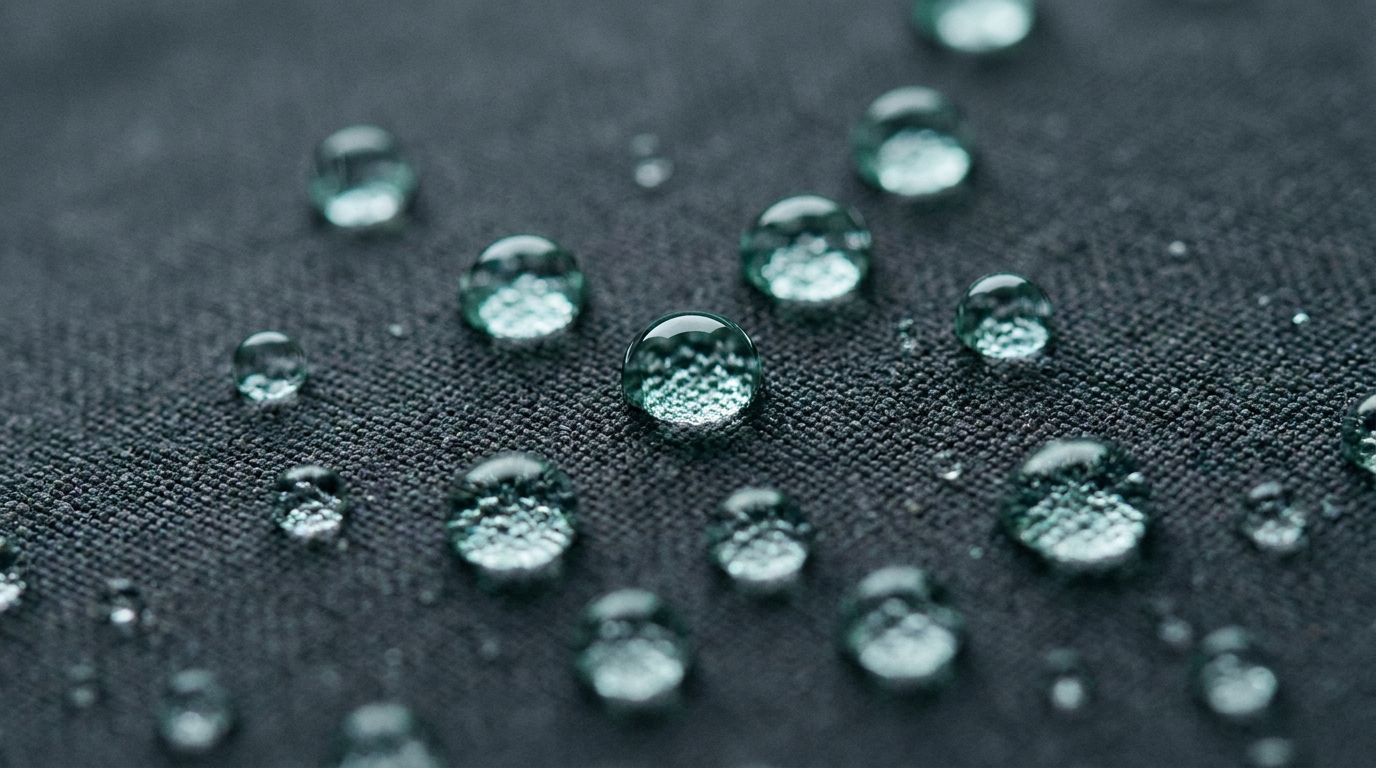
Here is a rare, genuinely good piece of news about "forever chemicals": in a lot of rain jackets, they are on their way out — and this time there is lab data to prove it.
On 8 June 2026, the Natural Resources Defense Council (NRDC) published "No PFAS, No Problem: Product Testing Reveals Success of CA and NY PFAS Textile Laws." The group bought and tested 115 textile products in California and New York. The headline finding: in some major outdoor brands' raincoats — historically one of the most PFAS-laden categories there is — PFAS levels had fallen by 97 to 99.99 percent since the two states' bans took effect.
That is the part worth sitting with. Not long ago, the textile industry's common line was that you could not get durable water- and stain-resistance without PFAS. The NRDC data says otherwise: once two states drew a hard line, a whole product category reformulated — fast.
What actually changed
Two state laws did the work, both effective 1 January 2025:
- California (AB 1817): bans textile articles containing regulated PFAS at or above 100 ppm total organic fluorine — a threshold that drops to 50 ppm in 2027.
- New York: bans apparel containing PFAS as intentionally added chemicals.
Across the 115 products, most now comply: 79% tested below 100 ppm, 70% below 10 ppm, and 60% below 5 ppm.
Once two states drew a hard line, a whole product category reformulated — fast.
The honest caveat: it is not universal
Good news, reported honestly, includes the gaps. NRDC still found concerning PFAS levels in a few categories that slip through — notably tablecloths, pet accessories, and reusable diapers. The accurate takeaway is "the bans work where they are enforced," not "PFAS are gone."
Does this mean my raincoat is PFAS-free?
Not necessarily — and this is where the story gets useful. "Reduced by 99.99%" and "PFAS-free" are different statements. What NRDC actually did was measure: independent laboratory testing on products bought off real shelves. The drop is credible precisely because it was measured on the finished product, not asserted by a hangtag.
How was the drop measured?
PFAS in textiles is typically screened by total organic fluorine: because there are thousands of individual PFAS, measuring total fluorine catches the whole class at once, and a low result means no meaningful PFAS is present. A result is always reported as "below [X] ppm", never a literal zero, because a test can only report down to its detection limit. That is exactly how the California and New York thresholds are written — as fluorine limits.
What this means for manufacturers and brands
PFAS-free performance is now demonstrably feasible. The "we can't hit performance without PFAS" argument is far harder to make when independent testing shows an entire category did it in two years. Retailers and private-label buyers have noticed, and the regulatory floor keeps rising — California's 50 ppm step in 2027, more states, and the EU's PFHxA textile limit landing in October 2026.
The catch is the claim. Under Canada's amended Competition Act (Bill C-59/C-15) and similar rules, a "PFAS-free" claim needs an adequate and proper test made before the claim — not a supplier's word. The brands that came out well in NRDC's testing are the ones who can show the number.
How CAGE approaches this
The 99.99% drop is real for one reason: someone measured it — independent laboratory testing on finished products, not a brand's promise. That is the whole idea behind independent verification. A "clean" claim only means something when there is a method and a number behind it. CAGE runs blind, method-based testing so an "X-free" claim rests on a documented result — reported as "not detected above [X] ppm by [method]," never a bare "zero."
Sources
- NRDC, No PFAS, No Problem: Product Testing Reveals Success of CA and NY PFAS Textile Laws (8 June 2026).
- California AB 1817 — textile PFAS restriction (100 ppm from 2025, 50 ppm from 2027).
- New York — apparel PFAS (intentionally added) restriction, effective 1 January 2025.
- Bergeson & Campbell; WWD/Sourcing Journal — coverage of the NRDC testing (2026).