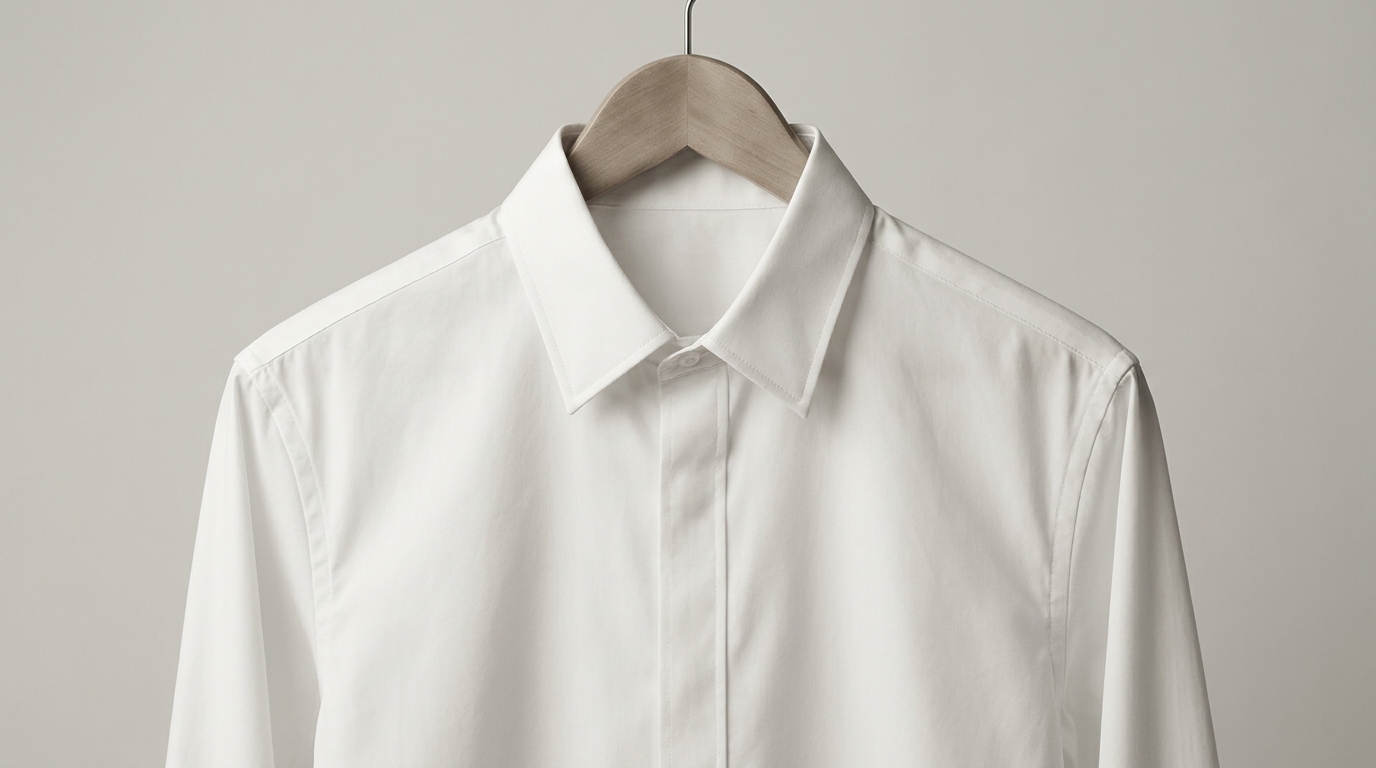
If a cotton shirt is sold as "wrinkle-free," "non-iron," or "easy care," its smooth finish was almost certainly produced by a cross-linking resin cured onto the fabric — and for decades the dominant chemistry in that category has been formaldehyde-based. A side effect is that small amounts of formaldehyde can remain in, and slowly release from, the finished garment.
That classification, from the World Health Organization's International Agency for Research on Cancer, is based on evidence linking formaldehyde to nasopharyngeal cancer and leukaemia. The U.S. National Toxicology Program lists it as "known to be a human carcinogen." For everyday clothing, though, the better-documented consumer effect is skin irritation and allergic contact dermatitis — formaldehyde is a recognised contact allergen.
How much is actually in clothing?
Usually low, occasionally high, rarely disclosed. A 2010 U.S. Government Accountability Office study tested a sample of U.S. clothing and found most items had low or non-detectable formaldehyde — but a minority, concentrated in wrinkle-resistant items, exceeded voluntary international guidance. The benchmark most testing is measured against is 75 parts per million, a threshold that traces back to Japan's Law 112 and is embedded in voluntary standards such as OEKO-TEX. Measurement is standardised by AATCC Test Method 112 and ISO 14184.
A "non-iron" shirt that is legal to sell in the U.S. may not be compliant for sale in the EU or Japan.
What the rules require — and don't
United States: there is no federal limit on formaldehyde in apparel. California's Proposition 65 requires a warning above a threshold, but that is a warning regime, not a content cap. European Union: since REACH Annex XVII entry 72 began applying on 1 November 2023, formaldehyde in most clothing is capped at 75 mg/kg. Japan and China have long enforced binding limits tiered by how close the item sits to the skin.
How CAGE approaches this
CAGE Innovations works on formaldehyde-free durable finishes for the easy-care category and on blind third-party testing against the recognised methods (AATCC 112 / ISO 14184), so a "formaldehyde-free" claim is a test-backed number, not an adjective.
Sources
- IARC, Monographs Vol. 100F — Formaldehyde (2012); U.S. National Toxicology Program, Report on Carcinogens.
- U.S. GAO, Formaldehyde in Textiles, GAO-10-875 (2010).
- ECHA, REACH Annex XVII entry 72 (applies from 1 Nov 2023); OEKO-TEX STANDARD 100 limit values.
- AATCC Test Method 112; ISO 14184; California OEHHA Proposition 65 list.